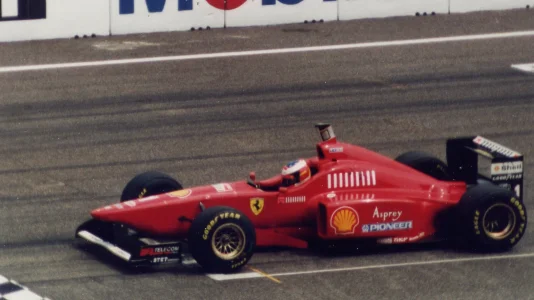
Michael Schumacher in the revised Ferrari F310 at the 1996 German Grand Prix.

Formula One is making station at Spa-Francorchamps for the 2026 Belgian Grand Prix - meaning it's the 30th anniversary of Michael Schumacher's second-ever victory for Ferrari.
Image: Matthias v. d. Elbe via Wikimedia Commons, available for distribution under the CC BY-SA 3.0 deed
Spa-Francorchamps was always a special place for Michael Schumacher once he arrived in Formula One. It was here that the German made his debut with Jordan in 1991, took his first-ever win just a year later, and wrapped up his final World Championship in 2004, among other memorable moments. Not all of them were happy memories, mind you, like when he almost had a fistfight with David Coulthard in 1998.
Wind the clock back by 30 years, and you will find another of those memorable moments for The Michael at Spa, and that was his second-ever win for Ferrari in a year that proved to be extremely tough for both the team and driver.

The Ferrari F310 in its early season specification with the low nosecone. Note the unusually large cockpit sides. Image: Jaimie Wilson via Flickr, available for distribution under the CC BY-NC ND 2.0 deed
There certainly was an improvement to Ferrari's form in those two years following the arrival of Jean Todt as Team Principal halfway through 1993, but they were nowhere near their glory days. An iconic team with the resources of Ferrari, plus the best driver in the world - that should be a recipe for certain success in 1996, right?
In reality, that turned out not to be the case. The Ferrari F310 was overweight, had Ferrari's first-ever V10 engine and the resulting reliability issues in the back, and the high cockpit sides that were mandatory for 1996 were interpreted suboptimally by designer John Barnard, to put it midly. The result was an ungainly car that wasn't very fast and also blew up frequently.
Schumacher wrestled the car to finishes that it shouldn't have been capable of - if he finished, that is. He suffered five DNFs all year, and two in particular stand out as low points: Monaco, where he crashed out on the very first lap after starting from Pole Position, and Magny-Cours, where the engine called it quits on the formation lap.
Yet, Schumacher had managed to score a his first victory for Ferrari at Catalunya in very wet conditions, and had racekd up a third and two second places before that. Teammate Eddie Irvina, who was also new at Ferrari, struggled even more despite an encouraging third in the opening round in Australia, only adding seven more points to his tally over the course of the season.
Perhaps most impressively, though not for positive reasons, the Northern Irishman racked up a series of eight successive retirements from the Spanish to the Italian Grand Prix.
Ferrari did work to improve the car throughout the year, introducing a high nose for the Canadian Grand Prix, which vastly improved its aerodynamics. That also meant that Ferrari was the last team to make this switch - even backmarkers Footwork, Minardi and the hopeless Forti had made the switch at that point.
Things weren't off to a great start at Spa, either: In Friday practice, Schumacher lost control of his car exiting Rivage, and he hit the wall backwards in the following left-hander that's usually referred to as Speaker's Corner today. Luckily, a bruised knee was the only injury he picked up.
And that certainly did not hinder him: Come Sunday afternoon, the Ferrari with the number 1 on its (high) nose sat in third position on the grid, behind the two Williams. What followed was another demonstration of the reigning champion's skill: At the start, he immediately overtook Hill, then set out to chase Pole Sitter Jacques Villeneuve.
Despite the Williams being the vastly superior car, Schumacher kept pace with Villeneuve, who reportedly used Grand Prix 2 to learn F1 circuits for his debut season, the gap between them fluctuating between 1 and 1.5 seconds.
The field was in for a bit of a breather on lap 12: Verstappen had pitted with a stuck throttle, but was sent back out as the Footwork crew could not find anything wrong. The Dutchman promptly crashed heavily on the exit of Stavelot, bringing out the Safety Car, though a faulty wheel bearing was later found to be the reason rather than a stuck throttle.

The Ferrari F310 livery of the 1996 Season Pack on AMS2's Formula V10 Gen 1 car. Image: @LadyCroussette
So for the final portion of the race, Schumacher was looking at a hotshot rookie in a much better car in his rear view mirror. Villeneuve managed to make the gap smaller, but not enough to be within striking distance. The Williams did emerge just ahead of Schumacher after the final stop, but Schumacher rocketed past with the extra momentum he had.
Again, Villeneuve got close, but not close enough. Schumacher leaned on his experience at the track and played his cards right, dragging the F310 that even Designer Barnard later admitted to be terrible to victory against the superior Williams. In the end, the gap was 5.6 seconds.
In the post-race press conference, Schumacher stated that the result came completely unexpectedly:
It wouldn't be the last win for Schumacher in 1996, either: Just two weeks later at Monza (Ferrari's home Grand Prix, of all places), he dragged the 'Red Cucumber', as the German press had dubbed the F310, to victory again following Hill's crash from a comfortable lead, lapping everyone up until P5, where Barrichello was the final car still on the lead lap.
A strong finish to 1996 followed with a third and a second at Estoril and Suzuka - and in 1997, Ferrari was back in the hunt for the title following the acquisition of two key people from Schumacher's glory years at Benetton: Designer Rory Byrne, who heavily revised the car to its F310B spec, and Technical Director Ross Brawn. And we all know how well that worked in the years to come.
Do you remember the 1996 Belgian Grand Prix? Let us know in the comments below!
Image: Matthias v. d. Elbe via Wikimedia Commons, available for distribution under the CC BY-SA 3.0 deed
Spa-Francorchamps was always a special place for Michael Schumacher once he arrived in Formula One. It was here that the German made his debut with Jordan in 1991, took his first-ever win just a year later, and wrapped up his final World Championship in 2004, among other memorable moments. Not all of them were happy memories, mind you, like when he almost had a fistfight with David Coulthard in 1998.
Wind the clock back by 30 years, and you will find another of those memorable moments for The Michael at Spa, and that was his second-ever win for Ferrari in a year that proved to be extremely tough for both the team and driver.
The Ferrari F310 in its early season specification with the low nosecone. Note the unusually large cockpit sides. Image: Jaimie Wilson via Flickr, available for distribution under the CC BY-NC ND 2.0 deed
Schumacher & Ferrari In 1996: Trying Times
After four full seasons plus part of another and two World Championships with Benetton, Schumacher was looking for a new challenge for 1996. He found that in Ferrari: The iconic team from Maranello had struggled since its 1990 title challenge with Alain Prost, winning only two races between 1991 and 1995 - Gerhard Berger was victorious at the 1994 German Grand Prix, and Jean Alesi famously won the 1995 Canadian Grand Prix.There certainly was an improvement to Ferrari's form in those two years following the arrival of Jean Todt as Team Principal halfway through 1993, but they were nowhere near their glory days. An iconic team with the resources of Ferrari, plus the best driver in the world - that should be a recipe for certain success in 1996, right?
In reality, that turned out not to be the case. The Ferrari F310 was overweight, had Ferrari's first-ever V10 engine and the resulting reliability issues in the back, and the high cockpit sides that were mandatory for 1996 were interpreted suboptimally by designer John Barnard, to put it midly. The result was an ungainly car that wasn't very fast and also blew up frequently.
Schumacher wrestled the car to finishes that it shouldn't have been capable of - if he finished, that is. He suffered five DNFs all year, and two in particular stand out as low points: Monaco, where he crashed out on the very first lap after starting from Pole Position, and Magny-Cours, where the engine called it quits on the formation lap.
Yet, Schumacher had managed to score a his first victory for Ferrari at Catalunya in very wet conditions, and had racekd up a third and two second places before that. Teammate Eddie Irvina, who was also new at Ferrari, struggled even more despite an encouraging third in the opening round in Australia, only adding seven more points to his tally over the course of the season.
Perhaps most impressively, though not for positive reasons, the Northern Irishman racked up a series of eight successive retirements from the Spanish to the Italian Grand Prix.
Ferrari did work to improve the car throughout the year, introducing a high nose for the Canadian Grand Prix, which vastly improved its aerodynamics. That also meant that Ferrari was the last team to make this switch - even backmarkers Footwork, Minardi and the hopeless Forti had made the switch at that point.
Ground To Make Up At The Belgian GP
Heading into Spa, Schumacher came off two non-podium finish, a fourth in Hockenheim and a ninth at Hungary - with no points scored at the Hungaroring, Schumacher sat in fourth in the standings, behind the Williams duo of Damon Hill and Jacques Villeneuve, as well as his successor at Benetton, Alesi.Things weren't off to a great start at Spa, either: In Friday practice, Schumacher lost control of his car exiting Rivage, and he hit the wall backwards in the following left-hander that's usually referred to as Speaker's Corner today. Luckily, a bruised knee was the only injury he picked up.
And that certainly did not hinder him: Come Sunday afternoon, the Ferrari with the number 1 on its (high) nose sat in third position on the grid, behind the two Williams. What followed was another demonstration of the reigning champion's skill: At the start, he immediately overtook Hill, then set out to chase Pole Sitter Jacques Villeneuve.
Despite the Williams being the vastly superior car, Schumacher kept pace with Villeneuve, who reportedly used Grand Prix 2 to learn F1 circuits for his debut season, the gap between them fluctuating between 1 and 1.5 seconds.
The field was in for a bit of a breather on lap 12: Verstappen had pitted with a stuck throttle, but was sent back out as the Footwork crew could not find anything wrong. The Dutchman promptly crashed heavily on the exit of Stavelot, bringing out the Safety Car, though a faulty wheel bearing was later found to be the reason rather than a stuck throttle.
The Ferrari F310 livery of the 1996 Season Pack on AMS2's Formula V10 Gen 1 car. Image: @LadyCroussette
Schumacher vs. Villeneuve: Early 1997 Preview
When racing resumed, the McLaren duo of David Coulthard and Mika Häkkinen were leading Schumacher, with Villeneuve in sixth - because he had missed the radio call to pit. The Canadian immediately went for aggressive overtaking maneuvers and gave chase. The Ferrari and the Williams cleared the McLarens after the next round of pit stops.So for the final portion of the race, Schumacher was looking at a hotshot rookie in a much better car in his rear view mirror. Villeneuve managed to make the gap smaller, but not enough to be within striking distance. The Williams did emerge just ahead of Schumacher after the final stop, but Schumacher rocketed past with the extra momentum he had.
Again, Villeneuve got close, but not close enough. Schumacher leaned on his experience at the track and played his cards right, dragging the F310 that even Designer Barnard later admitted to be terrible to victory against the superior Williams. In the end, the gap was 5.6 seconds.
In the post-race press conference, Schumacher stated that the result came completely unexpectedly:
It wouldn't be the last win for Schumacher in 1996, either: Just two weeks later at Monza (Ferrari's home Grand Prix, of all places), he dragged the 'Red Cucumber', as the German press had dubbed the F310, to victory again following Hill's crash from a comfortable lead, lapping everyone up until P5, where Barrichello was the final car still on the lead lap.
A strong finish to 1996 followed with a third and a second at Estoril and Suzuka - and in 1997, Ferrari was back in the hunt for the title following the acquisition of two key people from Schumacher's glory years at Benetton: Designer Rory Byrne, who heavily revised the car to its F310B spec, and Technical Director Ross Brawn. And we all know how well that worked in the years to come.
Do you remember the 1996 Belgian Grand Prix? Let us know in the comments below!